A First Arena Visit: Find Your Bearings Before Play
A first arena visit is easier when you read entrances, routes and gathering spaces before settling in, so you can move with less guesswork.
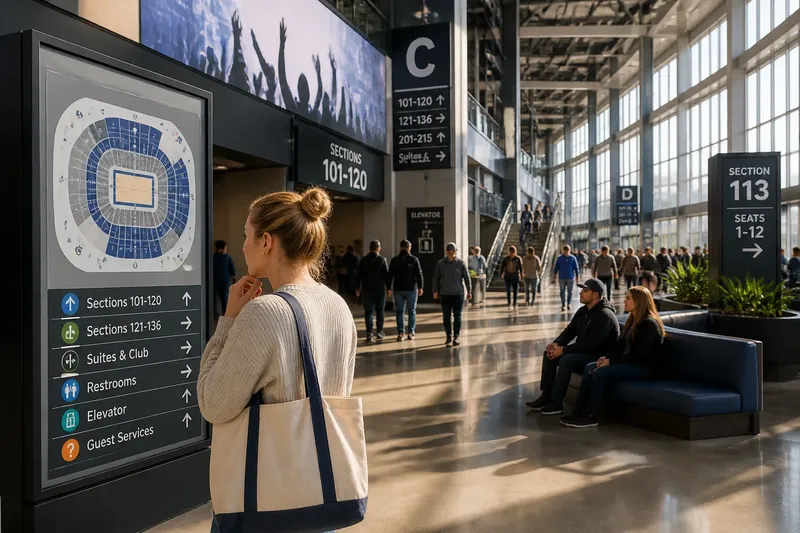
The common mistake on a first arena visit is choosing a destination before learning how the building moves. You head straight for a seat, a food counter or the nearest open doorway, then discover that the route back is crowded, closed or on the other side of the concourse. A few quiet observations before play can spare you the small but persistent cost of feeling lost in a building full of people who appear to know where they are going.
Read the arena from the entrance inward
Pause just inside the entrance, beyond the point where people are being checked through. Look for the arena map, section signs, stair and lift symbols, and the names or numbers used for entrances. A large building may use several naming systems at once: a gate letter outside, a door number at the bowl, and a section number on the ticket. Notice which one is used on the signs nearest you.
Then identify a fixed feature you can recognise on the way back: a prominent sign, a distinctive mural, a stairwell marked with a letter, or the end of a particular concourse. Treat it like a bookmark, not a destination. If the arena has several similar corridors, one recognisable landmark is more useful than a vague memory of passing a row of food counters.
Check the venue map against the direction you are actually facing. Maps are often printed in a way that makes sense on paper and less sense when held sideways in a noisy entrance hall. Turn it until its doors and corridors match the view ahead, then locate your ticketed section and the closest route towards it.
Follow circulation routes before the crowd thickens
Most arenas have more than one way between the entrance, seating bowl and shared concourse. A broad public corridor may connect several sections, while a narrower passage serves one block of seats. Look for the signs that distinguish the route to your section from the route to facilities or exits. The nearest visible stair is not automatically the right stair.
Notice where people are moving through and where they are stopping. Doorways, junctions and the foot of stairs need room for people trying to pass; they are poor places to consult a map or wait for a companion. Step into a wider alcove or against a wall where permitted, leaving the moving line clear. This is a minor courtesy with practical benefits: you can think without becoming an obstacle.
If you need to use a lift, find its location early and check the signs for accessible routes. Ask arena staff if the map or wayfinding is unclear. Routes can be arranged differently for different entrances or events, and a staff member can point out the appropriate public path without asking you to infer it from a stream of hurried visitors.
Do not assume that a corridor works in both directions throughout the event. Some venues manage entry and exit flows differently around busy periods, and a door that is open on arrival may later be controlled. Read signs as you pass, especially near stairs and bowl entrances, rather than relying on the route you remember from the way in.
Use shared spaces as orientation points, not camps
Concourse junctions, open plazas and broad areas beside public seating can make useful orientation points. They give you room to check a section number, meet someone or decide where to go next. A bench beside a wall is generally more workable for a brief pause than standing at a corridor crossing, where people are trying to move in several directions.
Food counters, merchandise stands and display areas create their own queues and eddies of people. Watch how those lines form before joining one: the queue may bend out of sight, or its tail may overlap a route to the seating bowl. Keep the walkway open, and look for a marked queue entrance rather than choosing the nearest gap. The arena is not a maze, but its queues can make a convincing impression of one.
Shared gathering areas vary in how they are meant to be used. Some are open circulation space; others have seats, tables or event displays that encourage people to linger. Check the signs and the room around you. If others are passing through steadily, keep your pause short and move to a clearly designated seating area if you want to stay longer.
Imagine you arrive with a companion and find the concourse around your section crowded. You spot a wide seating area near a marked junction, agree to meet beside its section sign, then walk to your seats by the indicated route. If one of you needs to return, the sign and junction provide a clear reference point, rather than a description such as “near the place with the drinks”.
Find the useful places without turning the visit into a tour
Before settling down, note the nearest public toilets, water point if available, information desk and accessible facilities relevant to your party. You need not visit each one. Knowing the direction and the sign to look for can make a later trip less hurried, particularly once people begin moving between the concourse and the bowl.
Check where staff are stationed and how to recognise them. They can clarify section access, direct you towards a public facility or explain a temporary closure. For a question about seating access, ticket conditions or a venue rule, use the staff point or the contact channel shown by the venue rather than relying on a guess from another visitor.
Some spaces have event-specific limits: a lounge may require separate access, a viewing area may be reserved, or a public route may be closed during play. Look for signs before entering. Where the right route or access conditions depend on the venue’s instructions or local rules, follow the posted guidance or ask staff.
What should you notice before heading to your seat?
Which entrance leads to your section?
Match the entrance named on your ticket or venue map to the signs in the building. If the labels do not line up, ask staff before joining a long queue or taking a route that may bring you to a restricted doorway.
Where can you pause without blocking people?
Look for a marked seating area, a broad alcove or another place where people are not funnelled through a narrow opening. Keep junctions, stair landings and queue entrances clear while you check directions or wait for someone.
Which landmarks will help you return?
Choose a sign, lettered stairwell or distinctive fixed feature visible from the route you will use. Memorise its position relative to your section, rather than relying on temporary displays or a counter that may be hidden by a queue.
What should you do if the map and signs disagree?
Stop in a clear area and ask an arena staff member to confirm the public route. A short question is more useful than following the largest crowd, which may be heading to a different section or facility.
Let the route inform where you spend time
Once you know how to reach your seats and the main shared spaces, decide whether you want to stay in the concourse or go into the bowl. Some visitors prefer to settle early and watch the warm-up or pre-play activity; others want a quieter pause before finding their section. Either choice is easier when you know how to return without retracing every turn.
Use the flow around you as a cue, not as an instruction. A sudden stream of people may be heading towards a gate, a facility or a popular counter. Check the sign above the route before following it, and allow room for visitors moving at a different pace. Arena circulation works best when people can choose a direction without having to negotiate a wall of spectators.
Before leaving a gathering area, take one last look at the signs pointing to your section and exit route. This is not an elaborate plan; it is simply the spatial equivalent of putting your keys in the same bowl. On a first arena visit, that small habit lets you spend less attention on finding the way and more on the event unfolding around you.