The Myth That Every Fan Needs a Matchday Ritual
A matchday ritual need not be fixed or elaborate. Find an approach that suits your routine, your companions and the way you want to watch.

The most common matchday mistake is treating a repeated routine as proof of proper fandom. It can turn an enjoyable habit into an obligation, with the small but real cost of making a match feel wrong before it has even begun. A matchday ritual can be personal, shared, occasional or absent; none is a membership test.
Rituals matter because they give ordinary actions a particular meaning. Pulling on a club shirt, stopping at the same café or exchanging predictions with a friend can mark the shift from the rest of the day to the event. But repetition is a way of expressing attachment, not a measure of it.
A matchday ritual is a choice, not a test
The word “ritual” can make a simple habit sound more solemn than it is. In sport, it may describe a familiar action repeated before play, a shared gesture in the stands, or a small personal cue that helps someone settle into watching. The meaning can come from the person doing it, from the people around them, or from the occasion itself.
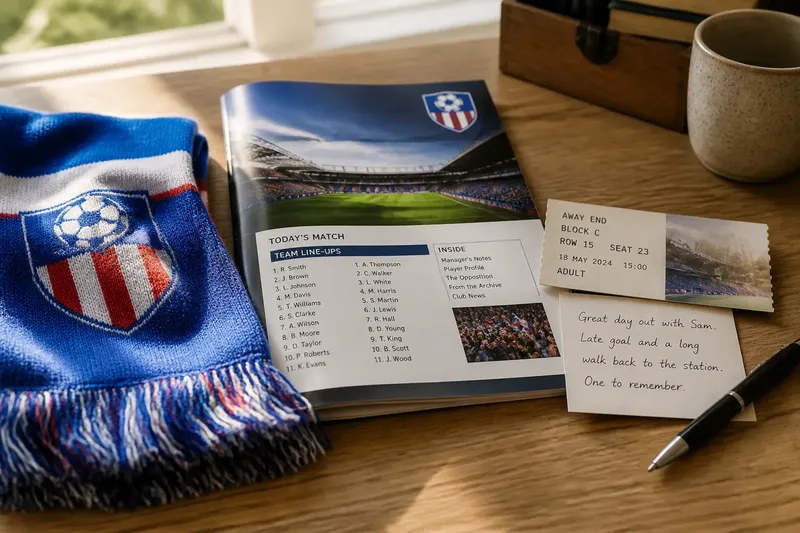
That leaves room for variation. One supporter might wear the same scarf for every home fixture; another might only put on team colours for a derby or a cup tie. Someone watching at home may make tea during the build-up, while a person who follows several sports may change their routine with the season. These differences do not need ranking.
The idea that every committed fan must have a fixed pre-match sequence is less useful. It confuses familiarity with devotion and assumes everyone has the same schedule, access and appetite for repetition. Some people enjoy a stable routine. Others arrive after work, join friends when they can, or prefer to meet each match without a prescribed set of motions.
Fixed routines suit fans who value a steady start
A fixed personal ritual repeats in much the same form from one occasion to the next. It might be wearing a particular shirt, listening to a familiar song on the journey, or reading the team news with a coffee before leaving. The action can create a clear boundary between everyday tasks and watching the match.
This approach often suits someone who likes predictability and has enough control over their schedule to keep a habit. A regular supporter might enjoy knowing that the same walk leads to the same meeting point, or that a familiar piece of clothing makes a weekday fixture feel like an occasion. The value lies in recognition, not in a claim that the routine affects the result.
A fixed routine can also become awkward when ordinary life interrupts it. A delayed train, a changed kick-off time or a shift at work may prevent one part of the sequence. If missing that part causes needless anxiety, the habit may be carrying more weight than intended. A ritual should help the person enter the event, not leave them feeling that they have already failed it.
Say you usually meet a friend at the same station before a home match, but one week they cannot come and your route changes. You could keep the part that matters to you—perhaps a short walk with a club podcast—without recreating the whole plan. The observable result might simply be that you still feel connected to the occasion, despite a different journey.
Shared rituals suit fans who enjoy belonging together
A shared ritual belongs to a group rather than to one person. It may be singing with other supporters, joining a family’s familiar pre-match meal, or taking part in a customary greeting at a supporters’ club. Its force comes from doing something in company: each person contributes to a moment that no individual has to carry alone.
This approach suits fans who find connection in collective gestures. It can be especially meaningful for people attending with relatives or friends, and for regulars who recognise familiar faces in a pub or on a terrace. A gesture need not be elaborate to feel shared. A nod to the person beside you can be enough when both understand what it means.
Group customs are not automatically welcoming, however. A long-standing song or joke may make sense to established members while leaving a newcomer unsure whether to join in. A shared ritual works best when participation is invited rather than demanded. Fans can belong to a crowd without performing every gesture in it.
Shared rituals also change as the group changes. A family’s matchday meal may shift when children grow older or relatives live farther away. Supporters’ groups may adapt a custom to suit a new venue or a different gathering place. Its meaning can survive a change in form, because continuity often comes from recognising one another rather than repeating every detail.
Occasional rituals suit fans whose matchdays vary
Some rituals are reserved for particular circumstances. A supporter might wear a special scarf for an away trip, visit a favourite café for a final, or call a parent before a match they used to watch together. These actions are not weaker because they are occasional. Their timing is part of what makes them distinct.
This approach suits people whose work, caring responsibilities, travel or ticket access make a regular routine impractical. It also suits anyone who prefers to mark only certain fixtures. A local league match may be an ordinary part of the week, while a cup tie or reunion with old friends calls for a more deliberate gesture.
Occasional rituals can hold personal memories without needing an audience. A particular scarf may recall an older sibling; a familiar tune may remind someone of watching matches at home as a child. The object or action need not be explained to be meaningful. Nor does its meaning depend on using it every time.
There is a useful distinction between choosing a special ritual and feeling forced to manufacture one. If a gesture matters, it can be kept for the occasions that suit it. If it has become inconvenient, it can be changed or set aside. Neither choice needs a public announcement.
No routine suits fans who prefer freedom or cannot rely on one
Having no set ritual is also a legitimate way to follow sport. Some fans enjoy the unpredictability of each matchday; others simply have no reason to repeat a particular action. They may decide what to wear, where to watch or whom to meet according to the day in front of them.
This can suit people with changing schedules, several teams to follow, or a preference for keeping sport separate from the rest of their routines. It may also suit a new fan who has not yet found a habit that feels natural. There is no need to borrow one from a more seasoned supporter merely to look the part.
Absence of routine does not mean absence of attention. A person can learn a team’s patterns, talk about the match, care about its outcome and value the people they watch with, all without repeating a pre-game sequence. A kitchen timer is useful because it does one job reliably; being a fan does not require arranging the day with the same mechanical neatness.
For some, the match itself is the ritual: the shared concentration, the pauses in conversation and the familiar arguments over a decision. That pattern may arise naturally without any planned clothing, food or journey. If nothing before the match feels necessary, that is information, not a deficiency.
Choose the ritual that fits the day you actually have
A practical way to choose is to ask what you want the action to do. Do you want a calm transition into watching, a moment of connection with other fans, a marker for a special fixture, or no additional structure at all? The answer can change by venue, opponent or company.
- Choose a fixed personal ritual if repetition helps you settle and your schedule allows it.
- Choose a shared ritual if joining in with friends, family or other supporters is the part you value.
- Choose an occasional ritual if certain fixtures or relationships deserve a distinct marker.
- Choose no set routine if flexibility feels more natural or your plans change often.
- Keep an easy alternative in mind if a chosen habit depends on a particular route, person or object.
There is no need to make the choice permanent. A weekday match may call for a quick trip straight from work, while a weekend fixture allows time for a café stop. The same supporter can enjoy a fixed shirt on one occasion, a shared song on another and no deliberate pre-match habit at all on the next.
If a routine stops feeling enjoyable, notice whether it is still doing what you wanted. You might keep its most meaningful part, loosen the timing, or leave it behind. That decision does not erase the memories attached to it.
Which matchday ritual fits your situation?
Do I need a ritual to count as a proper fan?
No. Supporting a team is not established by repeating a particular action before play. Attention, connection and enjoyment can take forms that do not involve a routine.
Can a matchday ritual change from game to game?
Yes. A ritual can be linked to a particular venue, person or important fixture, and it can change when circumstances do. A changing habit is still meaningful if it suits the occasion.
What if my friends expect me to join their routine?
You can take part in the elements you enjoy and decline the rest without challenging the group’s custom. A welcoming ritual leaves room for different levels of participation.
How do I know if a routine has become a chore?
Notice whether missing it leaves you disappointed in the matchday itself, rather than merely inconvenienced. If the habit creates more pressure than pleasure, simplify it or skip it.
A matchday ritual is useful when it gives an occasion the shape you want, whether that shape is personal, shared, occasional or deliberately unplanned. The best measure is modest: does it make watching feel more like your own? If not, the fixture will still begin without it.