Why Arena Sightlines Begin Before the First Seat
Arena sightlines depend on the playing area, viewing angle and seat layout. Learn what to inspect before choosing a seat and what each view reveals.
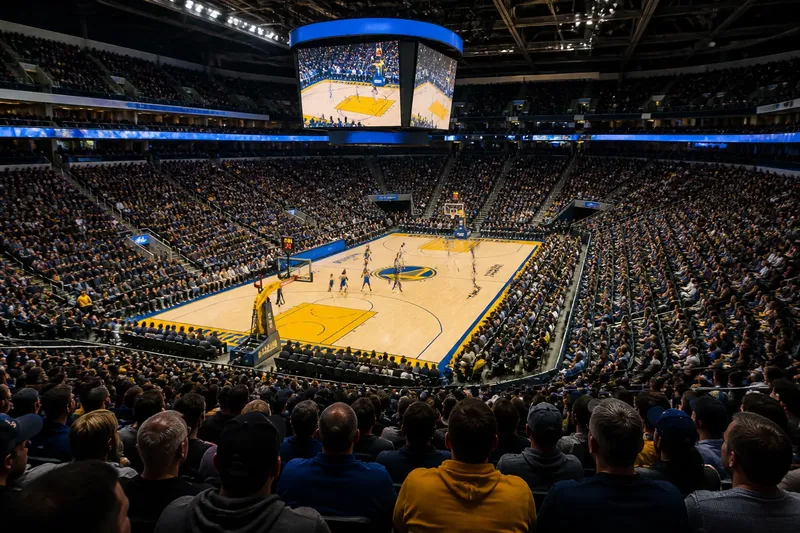
The common mistake in judging arena sightlines is to start with the seat map and stop at the row and section. That can cost you a clear view of the action that matters: a court-side seat may put a far touchline behind a player, while a higher one can make movement easier to read. Arena sightlines begin with the playing area, then the angle from which a seat meets it.
Start with the shape of the playing area
Before comparing seats, identify the sport and the dimensions and markings that organise its action. A basketball court, an ice rink and a football pitch ask different things of a spectator. The court or pitch shape affects how much of the far side is visible, while boards, goals, nets and team areas can interrupt particular views.
Look for the places where play tends to gather, but do not assume the decisive action always stays there. In basketball, the basket and the space around it draw attention; in ice hockey, the goals and the areas beside them matter. A seat aligned with one end may make that end feel close and legible, while the opposite end looks compressed.
Notice also what counts as a useful view for you. Following the ball or puck is different from reading the spacing between players, seeing a referee’s signal or watching a coach’s reaction. The best seat for one task may be an awkward seat for another.
Compare viewing angle with distance
Distance is easy to understand on a map; angle takes a little more imagination. From a seat behind a goal, the action at the near end may be easy to follow, but players can overlap when they move towards the far end. From the side, movement across the playing area may be clearer, though the far boundary is more distant.
Think of the view as a page held at an angle: the farther edge appears narrower, even though nothing on the page has moved. In an arena, that foreshortening can make depth and spacing harder to judge. Moving higher may improve the view across the whole playing area, but it can make individual expressions and small gestures less distinct.
Do not treat height as a simple ladder from poor to good. A low seat can make speed and physicality vivid; a higher seat can reveal patterns that are hard to see from beside the action. What matters is whether the angle leaves the important area open and whether the distance suits the detail you want.
Read the seating layout as a set of trade-offs
Use the venue’s seating plan to find the sections around the playing area, then check whether the diagram identifies a stage, rink, court, pitch or other event configuration. Some venues change their layout between sports or performances. A plan that looks central for one configuration may not be central for another.
Compare seats by the direction they face, not only by their section label. A corner seat can provide a useful diagonal view, showing two boundaries at once, but the far corner may be partially hidden by the angle. A seat near an end may offer a strong view of attacks approaching that end and a less balanced view of play elsewhere.
Check for likely obstructions shown on the plan or mentioned in the seat description. Railings, protective netting, glass, camera positions, support columns and the edge of a players’ bench can affect a line of sight. Their effect depends on where they sit relative to your seat and the playing area; a feature that blocks one part of the view may leave another untouched.
Say you are choosing between a low seat behind one basket and a higher seat near the centre line for a basketball game. If you most want to watch attacks develop across the court, the higher central angle may make player spacing easier to follow; if you want to feel close to action at that basket, the low seat may suit you better, while the far end will appear less clear. Neither choice is universally better: the useful decision follows from what you want to see.
Use venue images and seat details carefully
When a venue provides a view-from-seat image, use it to check the angle and nearby obstructions, not as a promise that every event will look the same. Images can be taken from a particular point and under a particular setup. Compare more than one view if the venue supplies them, especially for seats near a corner or an end.
Look for information about protective screens, netting and accessible viewing areas where those details affect your needs. A transparent barrier may still change the view through reflections or framing, while netting can be more noticeable against bright backgrounds. If a listing is unclear, ask the venue about the specific section and event layout rather than relying on a generic picture.
For a particular event, the venue’s current seating information and any event-specific layout are more useful than a general arena diagram. Where the right answer depends on the event configuration, venue information or local rules, check the venue’s own guidance once before deciding.
What should you check before choosing a seat?
Is a side-on seat always the clearest?
No. A side-on seat can make movement across a court or rink easier to read, but distance and elevation still matter. A low or distant side view may leave far-side details hard to distinguish.
Does sitting higher always improve the view?
Not always. A higher seat can reveal patterns across the playing area, while a lower seat can make close action feel more immediate. Decide whether broad context or nearby detail matters more to you.
How can I judge whether a seat has an obstruction?
Check the seat description, venue plan and any view-from-seat images for railings, netting, glass, columns or equipment. If the information does not show the relevant angle, ask the venue about that section and event setup.
Why might the same seat feel different at another event?
The event may use a different playing area or seating configuration, and the action may gather in different places. A seat that suits one sport’s shape and movement may give a less useful view of another.
Make the choice around the view you want
Before booking, name the part of the event you most want to follow: the full formation, play near one end, close physical detail or the movement of officials and players around the action. Then compare the playing area, your angle to it, the distance and any likely obstruction. This keeps the decision tied to what the seat can show rather than to a label on the seating plan.
Arena sightlines are a relationship, not a ranking. The playing area sets the visual problem; the angle and seating layout shape the answer. For a useful view, look for the seat that makes your preferred part of the competition easiest to read, while accepting what it places farther away.