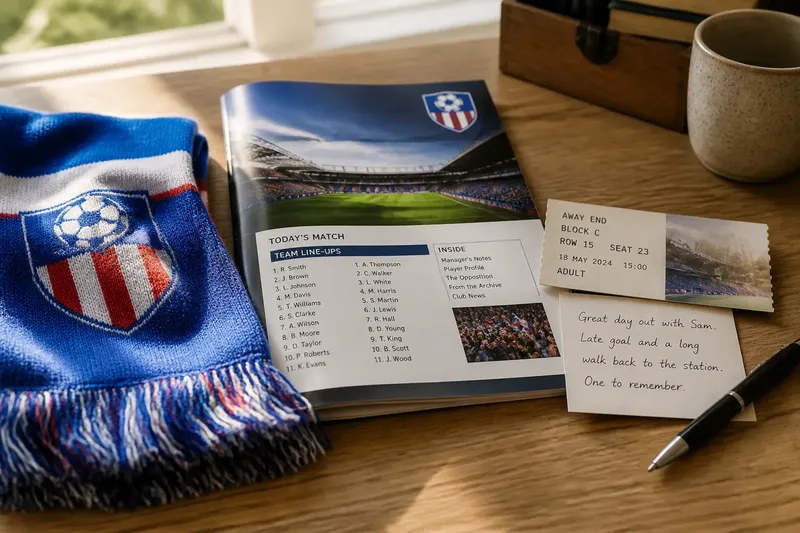
From Handwritten Scorecards to the Matchday Programme
From handwritten scorecards to the matchday programme, see how each form serves spectators by separating live scoring from fixture context and club identity.
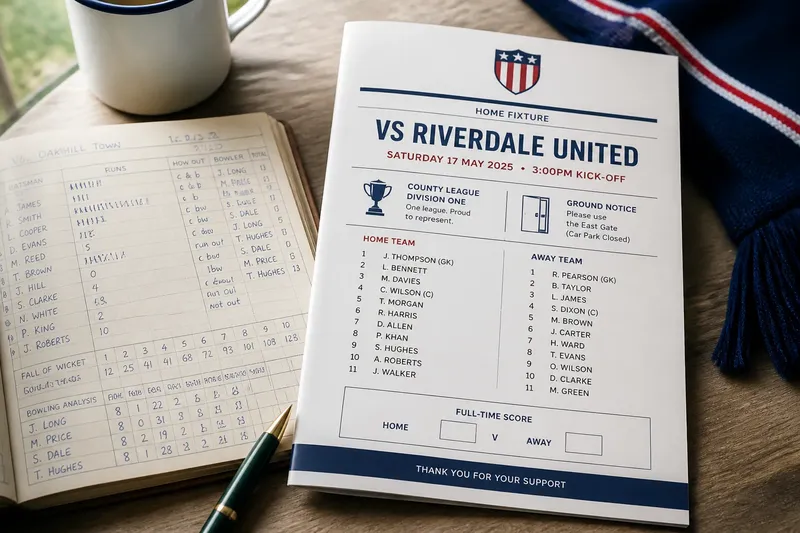
The common mistake is to treat a matchday programme as a souvenir with useful details attached. That flattens the distinction between a scorecard, which records play as it unfolds, and a programme, which can set out who is playing and what surrounds the fixture. Rather than claim a universal historical shift from one to the other, it is more useful to compare the jobs each printed form does.
Say a fictional local football club is preparing a home fixture. Its team has changed since the last meeting, some spectators are newcomers, and the organisers want a sheet that helps people follow the afternoon. The choices they make show how a scorecard and programme can work together without pretending that one simply replaced the other.
Handwritten scorecards record events as they happen
A scorecard is built around the action and the rules of a particular sport. In cricket, a scorer can use ruled columns and compact notation to track runs, dismissals and changes in the innings. The marks make a sequence legible to someone keeping score, but they are not necessarily an introduction to the teams or the occasion.
That narrow focus is a strength. Like a kitchen notepad beside a chopping board, a scorecard is made for a task in progress, not for explaining the whole household. Its format depends on the sport: cricket scoring does not transfer neatly to football, where a simple printed score area may be enough for a spectator’s notes.
In the fictional club’s archive, a volunteer finds a handwritten record from an earlier match. It contains the score and players’ names, but not the competition details a newcomer might ask about. The club can preserve that record while using a separate programme to supply the missing context.
A matchday programme gives the fixture context
A programme can name the sides, state the competition and introduce the people involved. It can also carry practical information, such as a change to the usual arrangements, alongside a short club note. Unlike a live announcement, its printed words can be checked again while a reader waits for play or looks at the line-up.
For its fictional fixture, the club puts the current team lists and a concise explanation of the competition on the sheet. It removes a general history paragraph that does not help explain this particular match. The expected visible result is a programme that answers immediate questions without asking readers to know the club’s past.
This does not establish a single historical route from scorecards to programmes. Clubs and sports have used printed forms for different purposes, and the surviving objects do not all tell the same story. The clearer distinction is functional: the scorecard follows play; the programme frames the occasion.
Editorial choices show which readers matter
Every item included takes space from something else. A player profile may give a newcomer a point of connection; a fixture list may help a regular follow the season; a note about the competition may explain why the match matters. The editor’s choices show whose questions the programme is designed to answer.
For the fictional club, the editor checks each proposed item against three needs: following today’s match, understanding its setting and remembering this particular occasion. If a long club history does not help with any of those needs, it gives way to current line-ups. If spectators need a changed entrance arrangement, that practical notice takes priority over a decorative profile.
- Check that the fixture date and opponents match the announced event; if either is wrong, correct it before printing, otherwise keep the details as listed.
- Check that every listed player is confirmed for the match; if a name is uncertain, mark the line-up as provisional or leave it out, otherwise print the confirmed list.
- Check whether a newcomer can identify the competition from the wording; if the format remains unclear, add a short explanation, otherwise keep the shorter description.
- Check whether any ground-arrangement notice has changed; if it has, place the current instruction prominently, otherwise omit an unnecessary notice.
- Check whether a proposed history item explains this fixture; if it does, retain the relevant passage, otherwise replace it with information tied to the day.
- Check whether there is room to note the final score; if there is, leave a clear space for readers to add it, otherwise prioritise the information needed before play.
The printed record matters after the final whistle
A scorecard is chiefly a record of play. A programme can preserve the announced teams, the competition as presented and the club’s chosen message, even when its score area is left blank. Its character comes from the details that attach it to one fixture, not merely from its status as printed paper.
In the fictional example, the club starts with confirmed team lists, the competition name, a changed entrance notice and a small space for the result. The editor checks the names against the team sheet, explains the competition in one sentence, moves the entrance notice to the front, then leaves the score area unfilled before the match. The resulting programme gives arriving spectators the information they need and lets a supporter add the outcome afterwards; the trade-off is less room for general club history.
The scorecard and programme can therefore overlap without competing for the same purpose. One gives a structured record of play; the other places the fixture among names, context and club language. For a reader searching for the difference between handwritten scorecards and the matchday programme, that division of work is more dependable than a tidy story of historical replacement.
What should a matchday programme include?
Does a programme need a scorecard?
Not always. A simple score area can let spectators follow the result, while a sport with more involved scoring may need a format that explains its columns or symbols.
Should it include club history?
Include history when it clarifies a badge, rivalry or local connection relevant to the fixture. A general account that could be printed unchanged every week may be less useful than a current team list or competition note.
What makes a programme useful to newcomers?
Clear team names, competition context and essential ground information help people understand what they are watching. Avoid relying on insider shorthand where a brief explanation would do.
What makes it worth keeping afterwards?
Details tied to the particular occasion make a programme distinct: the announced line-up, a fixture-specific note or space to record the outcome. Repeated general material can explain club identity, but it may not help a reader distinguish one match from another.
A programme earns its place by serving the fixture
The fictional club’s sheet now has a defined job before and after play: it orients spectators, then offers a place to add what happened. The scorecard remains the more direct tool for recording a sequence of events; the programme connects that sequence with the people and setting around it.
When comparing handwritten scorecards with a matchday programme, ask what each page lets a spectator understand at the ground and remember later. A modest programme can be useful without claiming to preserve an entire club’s history; it needs to record the fixture’s context, and leave the score to the people who watched it happen.